
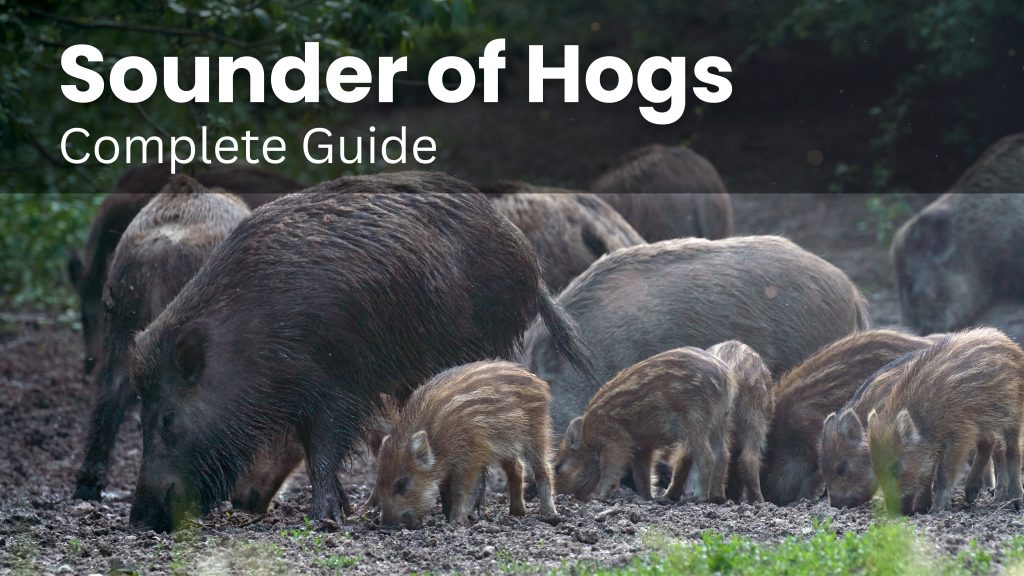
Sounder of Hogs — Complete Guide
What is a Sounder of Hogs?
A sounder of hogs represents the fundamental social unit of feral swine populations across North America. This term specifically describes a matriarchal family group consisting of adult females (sows) and their offspring of various ages. Understanding the dynamics of a sounder is crucial for anyone involved in wildlife management, agriculture, or property protection in areas where feral hogs have established populations.
The word “sounder” itself has Old English origins, derived from the Middle English term “sonder,” which referred to a herd of wild swine. Today, wildlife biologists and land managers use this technical term to distinguish these family groups from solitary boars or temporary breeding aggregations. A typical sounder operates as a cohesive unit, with members foraging together, sharing resources, and collectively protecting young piglets from predators.
Sounders exhibit remarkable social intelligence and communication. Members maintain contact through a variety of vocalizations, including grunts, squeals, and warning calls that can alert the entire group to danger within seconds. This sophisticated communication system makes sounders particularly challenging to manage, as they quickly learn to recognize and avoid threats, including hog trap systems that have been unsuccessfully deployed.
Biology and Social Structure of Sounders
The biological foundation of sounder formation stems from the reproductive strategy of feral hogs. Sows reach sexual maturity as early as six months of age and can produce two litters per year, with each litter containing four to twelve piglets. This extraordinary reproductive capacity means a single sounder can grow exponentially if left unchecked, potentially doubling or tripling in size within a single year under favorable conditions.
Within the sounder hierarchy, the oldest and most experienced sow typically assumes the role of matriarch. This dominant female makes critical decisions about foraging locations, movement patterns, and responses to threats. Her knowledge of food sources, water locations, and safe bedding sites becomes invaluable to the group’s survival, particularly during periods of environmental stress such as drought or extreme cold.
Sounder Size and Composition
Sounder size varies considerably based on habitat quality, food availability, and hunting pressure. In optimal conditions with abundant food resources, sounders may contain 20 to 30 individuals or more. However, most sounders typically range from 6 to 20 members, representing two to three generations of related females and their offspring. Larger sounders often split when they exceed the carrying capacity of their home range or when younger sows establish their own family groups.
The social bonds within a sounder extend beyond simple proximity. Members engage in mutual grooming, share wallows for cooling and parasite control, and coordinate their activities throughout the day. Piglets from different litters within the sounder often play together, developing the social skills they’ll need as adults. This complex social structure provides numerous benefits, including enhanced predator detection, improved foraging efficiency, and collective care of young.
Daily Activity Patterns
Sounders typically follow predictable daily patterns, though these can shift based on hunting pressure, temperature, and food availability. During cooler months, sounders often forage during daylight hours, while summer heat drives them to become primarily nocturnal. They establish regular routes between bedding areas, feeding sites, and water sources, creating well-worn trails that experienced trackers can identify and follow.
Understanding these patterns proves essential for effective management. Sounders often bed in thick cover during the day, emerging in late afternoon to begin their nightly foraging. They may travel several miles in a single night, visiting multiple feeding areas before returning to secure bedding sites before dawn. This predictable behavior allows managers to strategically place traps and monitoring equipment along frequently used travel corridors.
Why Sounders are Challenging to Manage
The intelligence and adaptability of feral hog sounders present unique challenges for wildlife managers and landowners attempting to control populations. Unlike many wildlife species that rely primarily on instinct, feral hogs demonstrate problem-solving abilities, memory retention, and social learning that rival those of many domesticated animals. These cognitive abilities, combined with their social structure, create a formidable opponent for traditional wildlife management techniques.
When a sounder encounters a threat or trap, the entire group benefits from the experience. If even one member escapes a trapping attempt, that individual’s wariness spreads throughout the sounder, making future capture attempts exponentially more difficult. This collective learning means that partial trapping success often results in long-term failure, as educated sounders become virtually impossible to capture using conventional methods.
Reproductive Resilience
The reproductive capacity of sounders compounds management challenges. A single escaped pregnant sow can rebuild a population within months, negating the efforts and resources invested in partial removal. With sows capable of producing 12 to 20 piglets annually under ideal conditions, population growth rates can exceed 150% per year. This biological reality means that removing 70% of a sounder may result in full population recovery within a single breeding season.
Environmental adaptability further complicates sounder management. Feral hogs thrive in diverse habitats, from wetlands to agricultural fields to suburban green spaces. Sounders quickly learn to exploit new food sources, whether agricultural crops, suburban landscaping, or natural mast production. This dietary flexibility allows them to survive and proliferate even when preferred food sources become scarce.
Intelligence and Communication
The sophisticated communication system within sounders enables rapid information transfer about threats. Alarm calls can alert members hundreds of yards away, triggering immediate flight responses that make capture difficult. Sounders also use scent marking to communicate, leaving chemical signals that warn other hogs about dangerous areas long after a trapping attempt has ended.
Research has documented sounders modifying their behavior in response to hunting pressure within days. Groups that previously foraged during daylight hours quickly shift to strictly nocturnal activity patterns. They also learn to avoid areas where they’ve encountered threats, sometimes abandoning productive feeding areas permanently after a single negative experience. This behavioral plasticity makes reactive management strategies ineffective against established sounders.
Whole-Sounder Trapping Strategy
The whole-sounder removal approach represents the gold standard in feral hog management, offering effectiveness rates 5 to 10 times higher than partial trapping methods. This strategy recognizes that capturing an entire sounder in a single trapping event prevents the education of survivors and eliminates the reproductive potential of the entire family group. Success requires careful planning, patience, and the right equipment, but the long-term benefits far outweigh the initial investment.
Implementing a whole-sounder strategy begins with thorough reconnaissance. Trail cameras positioned at bait sites allow managers to inventory sounder members, identify the matriarch, and understand group dynamics. This surveillance phase typically requires two to three weeks of observation to ensure all sounder members have been identified and are regularly visiting the bait site.
Pre-Baiting and Conditioning
Successful whole-sounder removal depends on conditioning the entire group to enter the trap area without hesitation. This process starts with establishing a consistent bait site that becomes part of the sounder’s regular foraging routine. Corn remains the most common bait due to its attractiveness and availability, though fermented corn or commercial hog attractants can enhance effectiveness in areas with abundant natural food sources.
The conditioning phase requires strategic patience. Managers must resist the temptation to activate traps when only part of the sounder enters, even if this means waiting several additional days or weeks. Modern net traps equipped with cellular cameras allow remote monitoring, reducing human disturbance while providing real-time intelligence about sounder behavior.
Trap Selection and Deployment
Choosing the appropriate trap design significantly impacts whole-sounder capture success. Large corral traps with gates wide enough to accommodate multiple animals entering simultaneously work well for smaller sounders. However, for larger groups or those exhibiting trap wariness, suspended net systems offer superior capture rates by eliminating the visual barrier of traditional trap walls that can deter cautious individuals.
Proper trap placement considers sounder movement patterns, prevailing winds, and escape routes. Positioning traps along established trails or near bedding areas increases visitation rates, while ensuring multiple hogs can enter simultaneously without crowding. The trap trigger mechanism must allow the operator to activate the trap remotely when all sounder members are present.
Benefits of Complete Sounder Removal vs Partial Trapping
The advantages of complete sounder removal extend far beyond simple mathematics of animals removed. When managers successfully eliminate an entire sounder, they prevent the cascade of negative consequences that follow partial trapping attempts. Complete removal eliminates the breeding potential of multiple generations simultaneously, prevents the education of survivors, and maintains the naivety of neighboring sounders that haven’t experienced failed capture attempts.
Economic analysis consistently demonstrates the cost-effectiveness of whole-sounder strategies. While the initial investment in equipment and time may exceed that of opportunistic hunting or small-scale trapping, the long-term reduction in crop damage, property destruction, and follow-up control efforts generates significant returns. Agricultural producers report damage reductions of 80-90% following successful whole-sounder removals, compared to temporary 20-30% reductions from partial control methods.
Ecological and Agricultural Benefits
Complete sounder removal provides immediate ecological benefits by eliminating concentrated rooting damage that can destroy native plant communities and accelerate erosion. Wetland areas particularly benefit, as sounder removal allows the recovery of sensitive plant species and improves water quality by reducing sedimentation. Native wildlife species that compete with feral hogs for food resources show population increases following successful sounder elimination.
Agricultural operations experience dramatic improvements in crop yields and reduced infrastructure damage following whole-sounder removal. Sounders can destroy entire fields overnight, with damage to corn, peanuts, and hay fields often exceeding thousands of dollars per incident. By removing entire sounders, farmers break the cycle of repeated damage that occurs when educated survivors return to productive fields despite deterrent efforts.
Disease Management Implications
From a disease management perspective, whole-sounder removal significantly reduces the risk of pathogen transmission both within feral hog populations and to domestic livestock. Sounders serve as disease reservoirs, with close contact between members facilitating the spread of pseudorabies, swine brucellosis, and other pathogens. Removing entire family groups breaks transmission chains more effectively than removing random individuals.
The concentrated nature of sounder social groups means diseases can spread rapidly through physical contact, shared wallows, and contaminated feeding areas. By eliminating complete sounders, managers prevent the establishment of endemic disease cycles that could threaten domestic swine operations and wildlife populations. This proactive approach to disease management becomes increasingly critical as feral hog populations expand into new regions.
Equipment and Methods for Sounder Trapping
Selecting appropriate equipment for whole-sounder capture requires balancing effectiveness, cost, and practicality for specific situations. Modern trapping technology has evolved significantly from simple box traps, with innovations in trap design, monitoring systems, and trigger mechanisms dramatically improving capture success rates. Understanding the strengths and limitations of different trap systems enables managers to match equipment to sounder size, behavior, and local conditions.
Corral traps remain the most common choice for sounder removal due to their reliability and relatively simple construction. These circular or rectangular enclosures typically measure 20 to 35 feet in diameter, constructed from heavy-gauge livestock panels capable of withstanding the impact of panicked hogs. The critical design element involves gates wide enough to allow multiple hogs to enter simultaneously without triggering flight responses.
Advanced Trap Designs
Suspended net systems represent the cutting edge of sounder trapping technology. These traps eliminate visual barriers that deter trap-shy individuals, using a suspended net that drops when triggered to contain the entire sounder. The absence of walls during the conditioning phase allows even the most cautious sounder members to feed comfortably beneath the net, dramatically improving whole-sounder capture rates.
Drop nets require specialized equipment including support poles, net suspension systems, and remote trigger mechanisms. However, their effectiveness with educated sounders and ability to capture 30 or more hogs simultaneously justifies the additional complexity. Proper net selection considers mesh size, material strength, and weight, with most successful operations using nets specifically designed for feral hog capture.
Monitoring and Trigger Systems
Modern cellular-enabled cameras have revolutionized sounder trapping by allowing real-time monitoring without human disturbance. These systems send images or video directly to smartphones, enabling managers to inventory sounder members, monitor conditioning progress, and activate traps at the optimal moment. Some advanced systems include artificial intelligence that can count hogs and send alerts when the entire sounder enters the trap area.
Trigger mechanisms range from simple rooter gates that hogs activate while feeding to sophisticated remote-controlled systems. Remote triggers prove essential for whole-sounder capture, as they allow activation only when all members are properly positioned. Cellular-controlled gates, electromagnetic releases, and pneumatic systems each offer advantages depending on trap design and local cellular coverage.
Common Mistakes in Sounder Management
Understanding common pitfalls in sounder management helps landowners and wildlife managers avoid costly mistakes that can make future control efforts exponentially more difficult. The most frequent and damaging error involves impatience during the conditioning phase, triggering traps before all sounder members consistently enter. This premature activation typically captures only the boldest individuals, leaving educated survivors that may never enter a trap again.
Another critical mistake involves underestimating sounder intelligence and communication abilities. Managers who approach feral hog control with strategies designed for other wildlife species often fail to account for the social learning that occurs within sounders. Using inadequate equipment, such as traps too small to hold an entire sounder or gates too narrow for multiple hogs to enter comfortably, virtually guarantees partial captures that complicate future efforts.
Inadequate Reconnaissance
Failing to properly inventory sounder members before beginning removal efforts represents a fundamental error that undermines the entire operation. Without knowing exact sounder composition, managers cannot determine when all members are present for capture. This reconnaissance phase requires patience and systematic camera placement to ensure accurate counts, including shy individuals that may only visit bait sites sporadically during initial conditioning.
Relying solely on hunting or opportunistic removal methods while ignoring complete hog management strategies creates educated populations that become increasingly difficult to control. Recreational hunting, while popular, typically removes less than 30% of populations annually and often targets the easiest individuals to locate. This selective pressure creates trap-shy, nocturnal sounders that cause damage while avoiding human contact.
Poor Timing and Environmental Factors
Attempting sounder removal during periods of abundant natural food represents another common mistake. When acorns, agricultural crops, or other preferred foods are readily available, sounders may visit bait sites irregularly, making whole-sounder capture unlikely. Successful managers time removal efforts for periods of food scarcity, when bait sites become irresistible to entire sounders rather than occasional supplements to natural foraging.
Ignoring weather patterns and seasonal behaviors leads to missed opportunities and failed captures. Extreme temperatures alter sounder movement patterns and feeding times. Heavy rains can wash away bait and make trap sites inaccessible, while drought may concentrate sounders around water sources. Understanding these environmental influences allows managers to adjust strategies rather than persisting with approaches unsuited to current conditions.
Communication and Coordination Failures
On properties with multiple landowners or managers, lack of coordination often sabotages sounder removal efforts. When neighboring properties conduct independent control efforts without communication, educated sounders simply shift their home ranges to avoid threats. Successful landscape-scale management requires cooperation between stakeholders to ensure coordinated removal efforts that prevent sounder education and maximize population reduction.
Finally, inadequate follow-up monitoring allows population recovery to negate initial control success. Even successful whole-sounder removal requires continued vigilance to detect and remove immigrating hogs before they establish new breeding populations. Managers who declare victory after initial removals often face renewed damage within months as surrounding populations expand into vacant habitat. Effective long-term control demands persistent monitoring and rapid response to new sounder establishment.