
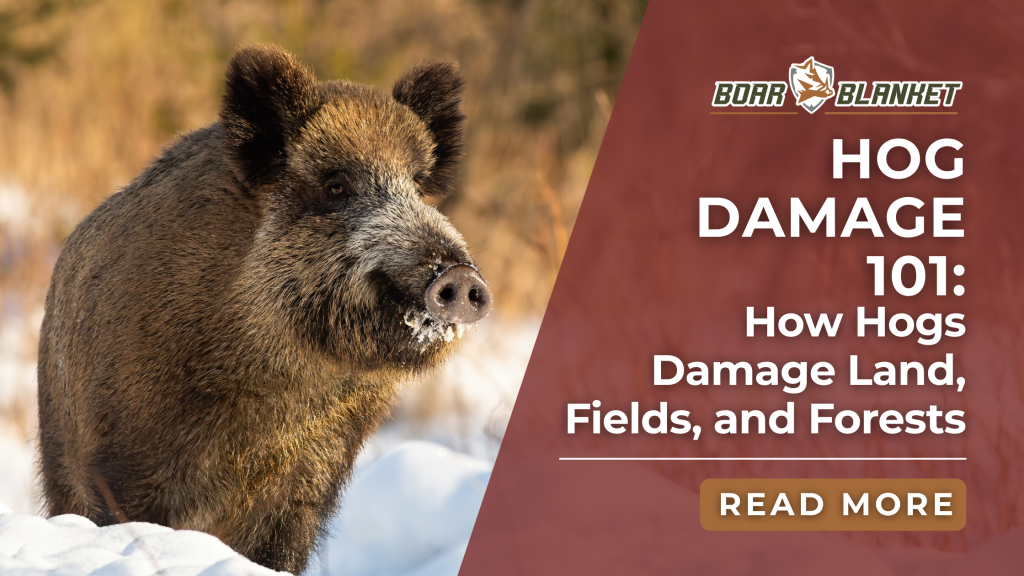
Wild hogs are responsible for some of the most severe and expensive hog damage in the United States. Their rooting, wallowing, and feeding behavior can destroy fields, pastures, forests, and food plots in a single night. What many landowners do not realize is how quickly this destruction compounds. A sounder does not simply pass through an area and leave; they return night after night, expanding the damage footprint as they search for new food sources and disturb the soil in every direction.
Understanding hog damage is essential for landowners who want to protect their property, livestock, and habitat. When you know what this destruction looks like, how it spreads, and why hogs behave the way they do, you can make faster, more informed decisions before the damage becomes irreversible.
A Closer Look at How Hog Damage Begins and Spreads
Before diving into lists and technical details, it helps to understand the bigger picture. Hog damage often starts quietly: a few rooting patches near a treeline, a subtle shift in deer activity, a feeder going empty faster than usual. These early signs usually go unnoticed.
Within days, those isolated rooting patches link together, forming long trenches of overturned soil. Trails begin to appear where hogs move in and out of feeding areas. Water sources become cloudy or contaminated. The land stops recovering naturally because the soil structure is repeatedly destroyed.
This pattern is why landowners frequently feel blindsided by how quickly damage escalates. The destruction is not random. It follows predictable behavioral patterns tied to food availability, weather, and sounder hierarchy. Recognizing this early progression is what allows you to intervene before the land reaches a point of costly recovery.
Why Understanding Hog Damage Matters
Hog destruction is more than cosmetic. It impacts soil health, livestock safety, crop yields, and long-term land value.
What Hog Damage Causes
- Crop loss
- Soil erosion
- Water contamination
- Habitat disruption for native wildlife
- Destruction of food plots and pastures
- Equipment damage (tractors, mowers, ATVs)
Statistics That Matter
- Wild hogs cause an estimated $2.5 billion in annual damage across the U.S.
- Texas alone reports more than $90 million in crop losses per year.
- A single sounder can uproot 10–20 acres in one night.
- Studies show hogs travel up to 5 miles per night while foraging.
The faster hog damage is identified, the sooner a landowner can respond.
How Hogs Destroy Fields and Pastures
Rooting
Rooting is the most common and destructive type of hog damage. Hogs use their snouts to dig for food such as grubs, roots, and buried crops.
What Rooting Does:
- Destroys soil structure
- Uproots crops
- Creates holes dangerous to livestock
- Promotes invasive plant growth
Trampling
Hogs move in groups, and their weight and hooves trample vegetation.
Trampling Leads To:
- Crushed seedlings
- Destroyed pasture grass
- Compacted soil that reduces regrowth potential
Feeding Raids
Hogs target:
- Row crops (corn, peanuts, soybeans)
- Food plots
- Hay fields
- Orchards
They often pull up crops at the roots, leaving bare soil behind.
How Hogs Damage Forests and Timberland
Rooting Under Trees
Hogs uproot soil around tree roots, exposing them and causing long-term stress.
Destroying Mast Production
Hogs consume large quantities of acorns, hickory nuts, pecans, and other mast, depriving:
- Deer
- Turkey
- Squirrels
- Native foraging species
Creating Erosion Channels
Deep rooting on slopes causes water channels to form, accelerating erosion.
Hog Damage in Wetlands and Water Systems
Hogs are highly destructive in wet areas.
Wallowing
They dig wallows in moist soil, which leads to:
- Muddy depressions
- Water pooling
- Soil compaction
Water Contamination
Hog activity contaminates ponds, creeks, and water troughs through:
- Fecal waste
- Disturbed sediment
- Harmful bacteria and parasites
Feral hogs are known to carry pseudorabies, leptospirosis, and E. coli, which can spread to livestock and wildlife.
Signs of Hog Damage on Your Land
Use this checklist to confirm hog presence.
Signs to Look For
- Deep, uneven rooting patches
- Shredded vegetation
- Multiple track sizes
- Fresh mud on trees
- Scat piles spread across fields
- Disturbed soil near water sources
- Uprooted crops or flattened rows
If you find multiple signs together, hog damage is active and expanding.
Learn more about hog damage in your state.
Why Hog Damage Spreads So Quickly
Hogs are fast-moving, intelligent, and feed in groups.
Key Reasons Damage Grows Fast
- Large sounders feed together
- Hogs return nightly to reliable food sources
- Rooting expands in all directions
- Sows teach juveniles destructive feeding habits
- Hogs shift to untouched areas when pressured
This is why isolated control efforts rarely work.
Feral hog damage is growing fast, learn more.
Why Hunting Does Not Stop Hog Damage
Hunting removes only a few individuals at a time.
Problems With Hunting as Control
- Scatters the sounder
- Teaches hogs to avoid hunters
- Causes nocturnal shifts
- Does not reduce overall population
Damage continues because the remaining hogs return within days.
Why Whole-Sounder Trapping Is the Only Reliable Solution
Removing the entire group stops damage immediately.
Whole-Sounder Trapping Benefits
- Eliminates pressure instantly
- Prevents pigs from returning
- Reduces rooting and wallowing
- Protects crops and pastures
- Supports long-term land recovery
Why the Boar Blanket Works Best
The Boar Blanket:
- Captures the entire sounder quietly
- Requires no electricity or cellular signal
- Works in mud, brush, timber, and uneven terrain
- Allows one-person setup
- Does not spook hogs like steel traps do
It is designed specifically for landowners in rural, off-grid, or heavily wooded environments.
Learn how to trap the whole sounder with Boar Blanket.
See the Boar Blanket in Action
Visit the Boar Blanket Case Study to watch how landowners stop hog damage and restore their land immediately after trapping an entire sounder.
FAQ
What does hog damage look like?
Deep rooting, torn vegetation, wallows, and trampled crops are common indicators.
How fast can hogs destroy a field?
A single sounder can tear up 10–20 acres in a single night.
Can hog damage be repaired?
Yes, but it is expensive. Removing the hogs is the first step.
What is the best way to stop hog damage?
Whole-sounder trapping using a passive system like the Boar Blanket.