
Introduction: The Fastest Growing Invasive Mammal in North America
Hog populations across the United States continue to rise despite decades of hunting pressure and state-level removal efforts. What surprises many landowners and new trappers is not just how destructive feral hogs are, but the speed of their population growth, even after consistent removal.
Across Texas, the Southeast, and parts of the Midwest, wildlife agencies consistently report the same finding: unless roughly 65–75 percent of a hog population is removed every single year, numbers will continue to grow. Traditional hunting rarely reaches even 30 percent. Trapping programs that do not capture full sounders achieve similar outcomes.
To understand why feral hogs expand so rapidly, we must look at their biology, behavior, and the environmental conditions that accelerate reproduction. The more trappers understand these factors, the more effective whole-sounder strategies become in the field.
The Biological Engine Behind Rapid Hog Reproduction
Research shows that feral hogs are one of the most reproductively efficient large mammals in North America. The following characteristics make their population growth uniquely difficult to control.
1. Early Sexual Maturity
Feral hogs reach breeding age much sooner than most landowners realize.
- Female sows: as early as 6 to 8 months
- Male boars: as early as 4 to 5 months
This means a sounder can include multiple generations of breeding females at once, compounding population growth with each cycle.
2. Multiple Litters Per Year
Unlike deer or other native wildlife, which have one seasonal breeding period, hogs can produce one to two litters every year, depending on forage availability and climate stability.
Each litter ranges from 4 to 12 piglets, though higher numbers are not uncommon during mild winters.
3. High Piglet Survival in Many Regions
Because hogs are omnivorous, adaptable, and highly mobile, they respond quickly when environmental conditions improve. Access to crops, acorns, supplemental feed, mud-based thermal cover, and low predation pressure often results in high juvenile survival rates.
In warm regions such as Texas, Louisiana, Mississippi, Georgia, and Florida, piglet survival can be especially strong due to longer growing seasons and consistent food supply.
4. Year-Round Breeding Cycles
As omnivores, hogs are not dependent on a narrow seasonal diet. If food is abundant, breeding continues uninterrupted.
This is why hog populations often surge after:
- Mild winters
- Wet springs
- Heavy mast years
- Large agricultural plantings
The population growth curve is directly tied to resource availability, and the curve almost always trends upward.
Key Reproductive Traits That Drive Hog Population Growth
| Biological Factor | Impact on Population Growth | Notes |
| Early sexual maturity | Increases number of breeding females | Females may breed before age one |
| 1–2 litters per year | Produces continuous population expansion | Each litter averages 4–12 piglets |
| Year-round breeding | Eliminates natural slow season | Driven by food availability not season |
| High survival of young | Produces more adults capable of breeding | Especially high where predators are limited |
| Social structure (sounders) | Allows coordinated group feeding and protection | Sounders can overlap and merge in high-food zones |
Sounder Structure: Why Group Behavior Accelerates Growth

Hogs do not operate as individuals. Their social structure fuels reproduction and expansion.
Female-Driven Groups
Sounders typically consist of:
- One or more adult sows
- Juvenile females
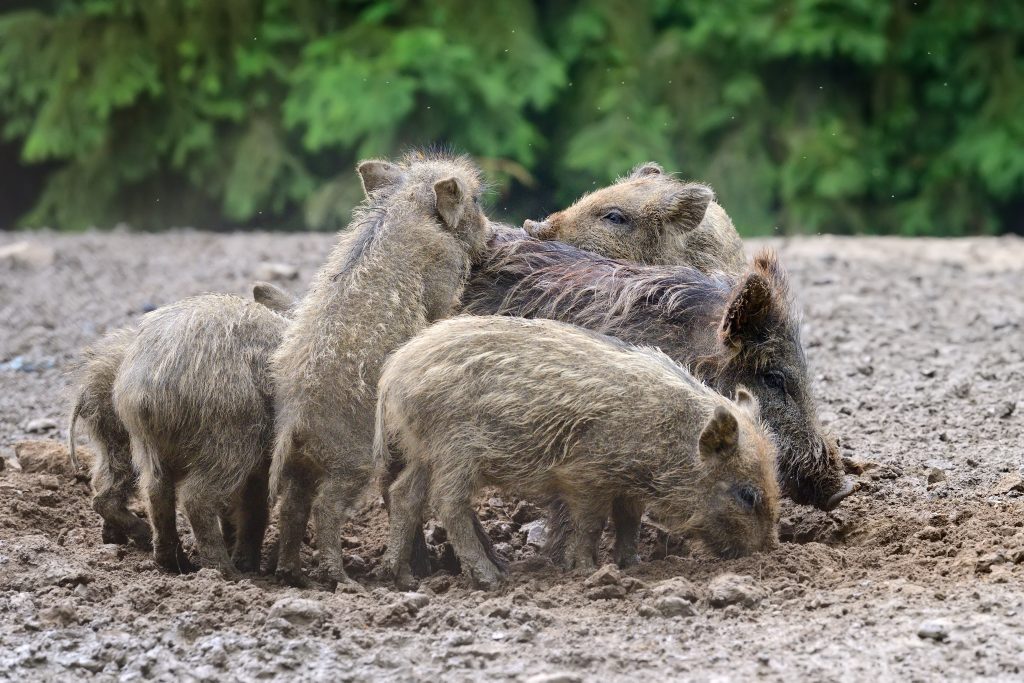
- Multiple age groups of piglets
Because sounders overlap forage areas, they quickly exploit new resources. When food availability increases, multiple females may breed simultaneously.
Males Disperse, Females Multiply
Young males often disperse into neighboring properties or counties, helping the species expand its range.
Females remain with the sounder and continue breeding.
This creates a dual-threat pattern:
- Range expansion through boars
- Population expansion through sows
Environmental Adaptability: Why Hogs Thrive Almost Everywhere
Feral hogs flourish in almost any habitat. Their success comes from a combination of traits:
- Ability to digest roots, grains, fruits, bulbs, tubers, insects, carrion, and small mammals
- Exceptional nose and rooting behavior that exposes hidden food sources
- Thick fat reserves that help them survive variable temperatures
- Capacity to shift feeding ranges when pressure increases
These adaptive traits lead to faster reproductive cycles because nutritional stress is rare in hog-dense regions.
For readers seeking deeper scientific background, the Feral Hog Crisis Report provides extensive national data on distribution, ecological impacts, and reproductive rates.
Why Populations Grow Even When Hunting Pressure Is High
A common belief among landowners is that heavy hunting pressure will slowly reduce hog numbers. Unfortunately, field data from wildlife agencies and university research suggests otherwise.
Hunting Removes Too Few Hogs
Studies show recreational hunting typically removes less than 30 percent of a local population.
To stabilize numbers, removal must exceed 65 percent.
To reduce numbers, removal must exceed 75 percent.
Hunting Alters Hog Behavior
When pressured, hogs quickly become:
- More nocturnal
- More mobile
- Less predictable in their feeding patterns
This makes effective trapping more difficult unless sounder-level strategies are used.
Partial Harvesting Intensifies the Problem
Taking one or two hogs from a sounder does little to reduce reproduction.
The remaining sows continue breeding, and in many cases, become more cautious and harder to trap.
This is why Whole Sounder Trapping is considered the most effective and efficient control method by wildlife agencies.
Case Study Insight: How Fast Populations Rebuild After Removal
Across multiple trapping operations documented in the Boar Blanket Case Study, landowners often capture 10–20 hogs at a site only to observe new sounders returning weeks later.
This is not due to trapping failure. Rather, it is evidence of:
- High reproductive turnover
- Boar-driven dispersal
- Adjacent sounders shifting into newly opened territory
These movements reveal how aggressive and persistent hog population dynamics are at the property level.
Why Understanding Hog Biology Matters for Every Trapper
Wild hogs are not spreading by accident. Their biology makes them one of the most prolific invasive mammals in the country. Effective control requires understanding:
- The pace of breeding
- The structure of sounders
- The environmental factors that drive survival
- The behaviors that influence trap timing
Education helps landowners and trappers shift from reactive control to strategic trapping based on group behavior and full-sounder opportunities.
The more we understand why hogs grow so quickly, the better prepared we are to slow the expansion and reduce long-term property damage.