
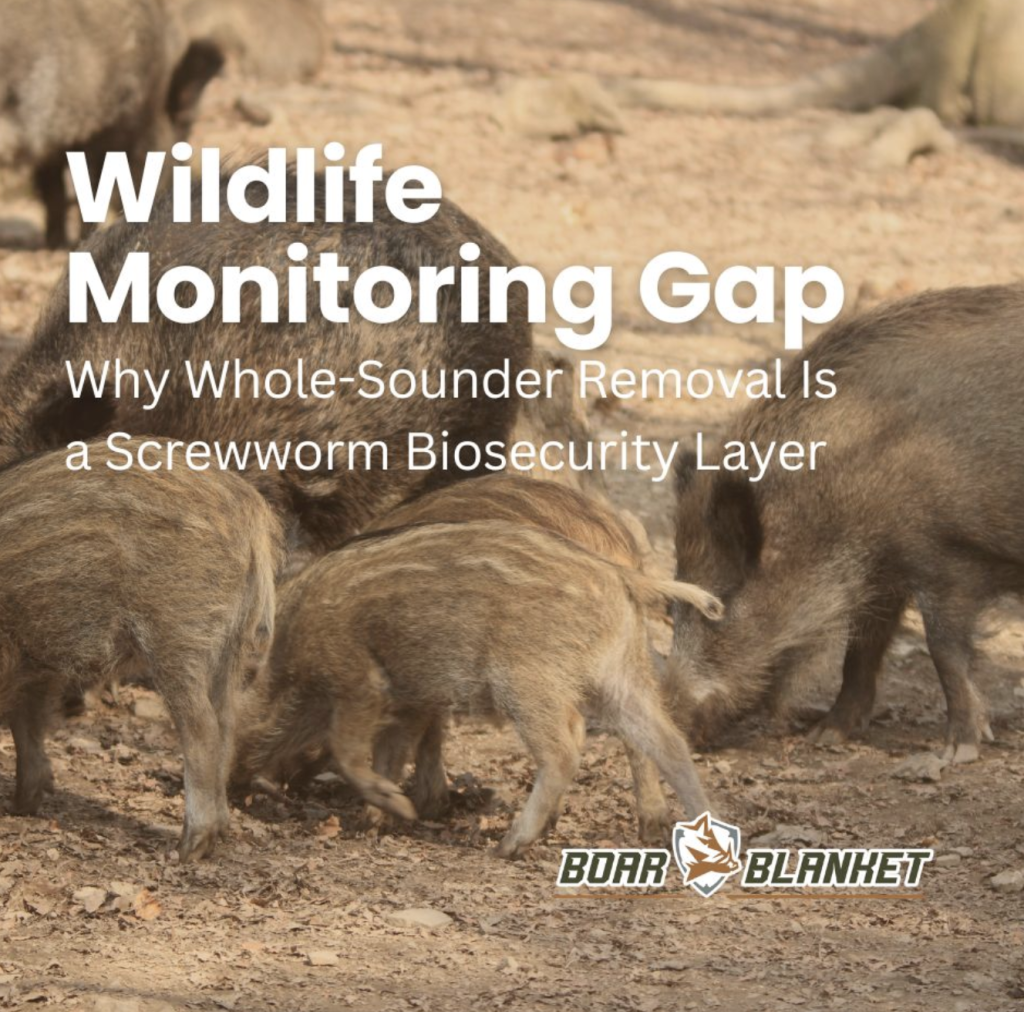
Cattle Are Watched. Wildlife Usually Aren’t.
On working land across Texas, Mississippi, Louisiana, Oklahoma, and Alabama, livestock get regular eyes on them. Cattle are moved, counted, and checked for wounds. Wildlife and feral hogs do not. That uneven attention is the wildlife monitoring gap: the same landscape holds animals you inspect and animals you almost never see up close.
With New World screwworm (NWS) back on the animal-health radar, that gap matters. This article is awareness and land-ops framing only, not veterinary advice. Clinical facts belong to USDA APHIS and your state animal-health authority.
The Live-Tissue Rule Still Comes First
NWS breeds on live animals (and, in some cases, very recently deceased ones). not on feces. The field line that cuts confusion: "If it’s on shit, that isn’t it." Maggots in manure or old carrion are ordinary flies. Maggots working in living wound tissue on a live animal are the risk that animal-health officials care about. See our plain-language explainer on what New World screwworm is.
Why Feral Hogs Widen the Gap
Feral hogs travel as much as ~6 miles a day, root and wallow in ways that create abrasions, and raise overall fly pressure on a property. They are wound-prone hosts that almost never get a close inspection. A dense, growing sounder population adds dozens of unmonitored animals to the same ground where cattle are carefully watched. That is why hog density shows up in biosecurity conversations even though hog control does not "treat" screwworm. For the risk mechanics, see why feral hogs accelerate screwworm spread risk.
| What gets monitored | Typical attention | Biosecurity implication |
|---|---|---|
| Cattle / horses | Daily or near-daily eyes | Wounds caught earlier |
| Deer / other wildlife | Rare close inspection | Host reservoir stays hidden |
| Feral hogs | Almost never inspected | Mobile, wound-prone, fly-attracting |
Whole-Sounder Removal as a Landscape Biosecurity Layer
Reducing feral hog numbers will not diagnose or treat screwworm. Animal-health professionals own that lane. What land managers can do is shrink the unmonitored host load on their own ground. The only approach that actually reduces a local population (instead of educating survivors) is whole-sounder removal: taking the complete family group in one capture event. Partial catches leave trap-shy animals that keep breeding. Our pillar on how whole-sounder trapping works covers the population math.
Where a Passive Net Trap Fits
The Boar Blanket net is built for that job on open feeding sites. You stage the net raised, pre-bait 5 to 10 nights (up to 14 for pressured sounders), confirm the whole group on camera, then return and manually lower the net. On the next visit, the hogs push under the skirt and trap themselves: passive self-entrapment, with no phone-actuated close and no drop mechanism. Details live on the Boar Blanket trapping system page.
What This Layer Is Not
Whole-sounder trapping is not a substitute for reporting a suspected screwworm case, not a clinical treatment plan, and not a claim that removing hogs eradicates NWS. It is one practical land-management layer: fewer unwatched hosts, less rooting damage, lower fly pressure around the sites you actually run. If you suspect screwworm, document and report to USDA APHIS and your state animal-health agency first. Awareness steps are in our how to spot screwworm landowner guide.
Ops Checklist for Land Managers
Confirm active sounders and feeding sites; keep bait refreshed so the group does not abandon the site; wait for the complete sounder before the gate or trap closes; and keep your reporting contacts ready if any animal shows live-tissue wound activity that looks wrong. Texas operators can start from buy a hog trap in Texas; browse regional options when you shop hog traps by state.
Frequently Asked Questions
- What is the wildlife monitoring gap?
Livestock are inspected regularly; wildlife and feral hogs usually are not. That uneven attention leaves unmonitored hosts on the same landscape. - Does removing feral hogs treat screwworm?
No. Treatment and diagnosis belong to veterinarians and animal-health authorities. Hog removal reduces unmonitored hosts and fly pressure, a biosecurity layer, not a cure. - Why does whole-sounder removal matter here?
Partial captures educate survivors. Removing the entire sounder is the only way to trap effectively and reduce local hog density. - Does New World screwworm breed in manure?
No. It breeds on live animals (sometimes very recently dead), not feces. If it’s on shit, that isn’t it. - How far can feral hogs move in a day?
About six miles a day, which spreads risk and activity across property lines. - What should I do if I suspect screwworm?
Document what you see and report to USDA APHIS and your state animal-health authority. Do not self-diagnose or treat. - Is this veterinary advice?
No. This is landowner awareness and hog-control operations framing only. - Where does the Boar Blanket net fit?
As a passive whole-sounder tool on open feeding sites after proper conditioning. Details on the trapping system page.