
What New World Screwworm Actually Is (and What It Isn’t)
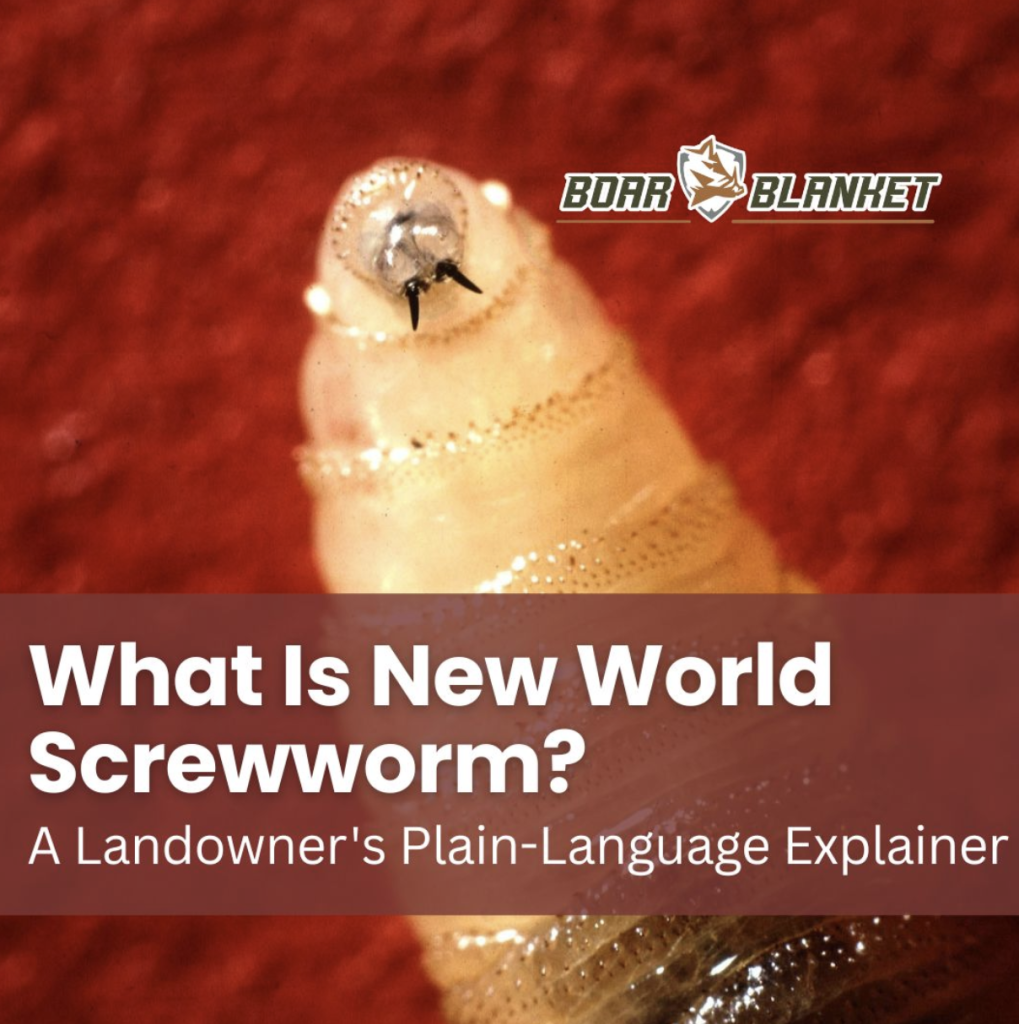
New World screwworm (NWS), the larval stage of the fly Cochliomyia hominivorax, is a parasite that feeds on the living tissue of warm-blooded animals. The name comes from the screw-like way the larvae burrow into a wound. Unlike the common flies that land on almost anything, screwworm has one defining habit that every landowner should understand: it targets live animals, not waste or long-dead carrion.
This is not a routine nuisance pest. According to the USDA Animal and Plant Health Inspection Service (APHIS), screwworm was eradicated from the United States decades ago, and federal and state animal-health officials treat any reintroduction as a serious threat to livestock and wildlife alike. That is exactly why awareness on the ground (on working land in Texas, Mississippi, Louisiana, Oklahoma, and Alabama) matters now.
How a Screwworm Infestation Develops on a Live Animal
The cycle starts with a wound. A female fly is drawn to even a small break in the skin: a tick bite, a castration or branding site, a fresh navel on a newborn, or a barbed-wire scrape. She lays eggs at the edge of that living tissue. When the larvae hatch, they feed on the live flesh, enlarging the wound and attracting still more flies. Left unaddressed, the infestation grows quickly and can become life-threatening for the animal.
The practical takeaway for landowners is that any animal with an open wound is a potential host: cattle, horses, sheep, goats, pets, deer, and feral hogs. The clinical details and treatment are a matter for your veterinarian and animal-health authorities. This guide is about recognizing the risk on your land, not treating a case.
Why "If It’s on Shit, That Isn’t It": The Live-Tissue Rule
Here is the single fastest way to cut through confusion in the field: "If it’s on shit, that isn’t it." New World screwworm breeds on live animals (and, in some cases, very recently deceased ones). It does not breed in manure, dung, or established carrion. If you see maggots in a cow patty, in spoiled feed, or in a long-dead carcass, that is ordinary fly activity, not screwworm.
That distinction keeps people from panicking over normal barnyard flies while staying alert to the thing that actually matters: maggots working in the living tissue of a wound on a live animal. When in doubt, do not guess. Document it and call the authorities listed below.
| Common belief | Reality | Why it matters |
|---|---|---|
| Maggots in manure could be screwworm | No. NWS breeds on live tissue, not feces ("if it’s on shit, that isn’t it") | Prevents false alarms on normal flies |
| Only livestock are at risk | Any warm-blooded animal with a wound, including deer and feral hogs | Wildlife and hogs are the blind spot |
| A small wound is no big deal | A small wound is exactly where an infestation starts | Early wound care and monitoring reduce risk |
| It’s a treatment problem for vets only | Detection and reporting happen on the land first | Landowners are the early-warning system |
Which Animals Are at Risk: Livestock, Wildlife, and Feral Hogs
Cattle producers watch their herds closely. They handle, move, and inspect cattle on a schedule. The harder problem is everything they can’t watch. Deer, other wildlife, and especially feral hogs roam the same ground, carry the same kinds of wounds, and are almost never inspected up close. A growing, unmonitored wild population is a reservoir of potential hosts moving freely across property lines.
Feral hogs deserve special attention. They travel as much as six miles in a single day, they wallow and root in ways that create skin abrasions, and their carrion and activity attract flies. A dense hog population doesn’t just damage crops and pasture. It raises the overall fly pressure and the number of unwatched animals on the landscape.
Why Landowners in TX, MS, LA, OK, and AL Should Pay Attention
The southern tier (Texas in particular, along with Mississippi, Louisiana, Oklahoma, and Alabama) combines warm climate, heavy livestock activity, and some of the highest feral hog densities in the country. That mix is precisely the environment where fly-borne risk is worth taking seriously. Staying informed and reducing avoidable hosts on your own ground is something every land manager can do now, regardless of where an outbreak stands.
Early Warning Signs on the Landscape
You don’t need to be a veterinarian to be a useful set of eyes. Watch for animals favoring a wound, foul-smelling sores that seem to worsen rather than heal, and visible larvae working in living tissue (not in waste). Pay extra attention around calving, branding, and any event that leaves fresh wounds. If something looks wrong, the right move is the same every time: document and report.
Who to Contact: USDA APHIS and Your State Animal Health Officials
If you suspect a case, contact USDA APHIS and your state animal-health authority right away. In Texas that is the Texas Animal Health Commission, and each state has its equivalent. Report first; do not attempt to self-diagnose or treat. Early reporting is how a single case is contained instead of becoming a regional problem.
Where Feral Hog Control Fits in Broader Land Biosecurity
Reducing feral hog numbers won’t treat screwworm. That’s a job for animal-health professionals. But it is a sensible biosecurity layer. Fewer hogs means fewer unmonitored hosts, less rooting and wallowing damage, and lower overall fly pressure on your ground. The most effective way to bring numbers down is whole-sounder removal: taking an entire family group at once rather than chipping away a few animals and teaching the rest to avoid traps.
If you’re thinking about hog control as part of a broader land-health plan, start with our comprehensive feral hog control methods guide and our breakdown of how whole-sounder trapping works. Texas landowners can go straight to options to buy a hog trap in Texas, and you can learn how the passive net approach works on the Boar Blanket trapping system page.
Frequently Asked Questions
- What is New World screwworm?
It’s the larval stage of the fly Cochliomyia hominivorax, a parasite that feeds on the living tissue of warm-blooded animals through an existing wound. USDA APHIS treats any U.S. reintroduction as a serious animal-health threat. - Is screwworm dangerous to livestock?
Yes. An untreated infestation enlarges the wound, attracts more flies, and can become life-threatening. Suspected cases should be reported to animal-health authorities immediately. - Does screwworm breed in manure or carrion?
No. It breeds on live animals (and sometimes very recently deceased ones), not on feces or established carrion. As the saying goes, "if it’s on shit, that isn’t it." - Can feral hogs carry or spread screwworm risk?
Feral hogs are unmonitored hosts that move up to six miles a day and raise overall fly pressure. They are a landscape risk factor, which is why controlling their numbers is a useful biosecurity layer. - What states are most at risk?
Warm southern states with heavy livestock and feral hog activity (Texas, Mississippi, Louisiana, Oklahoma, and Alabama) warrant the most awareness. - What should I do if I suspect screwworm on my land?
Document what you see and report it to USDA APHIS and your state animal-health authority. Do not attempt to diagnose or treat it yourself. - Who do I report a suspected case to?
USDA APHIS and your state animal-health agency (for example, the Texas Animal Health Commission). Report first, before taking any other action. - How is screwworm different from regular flies on an animal?
Regular flies and maggots are drawn to waste and dead material. Screwworm larvae feed in the living tissue of a wound on a live animal. That’s the key difference to watch for.