
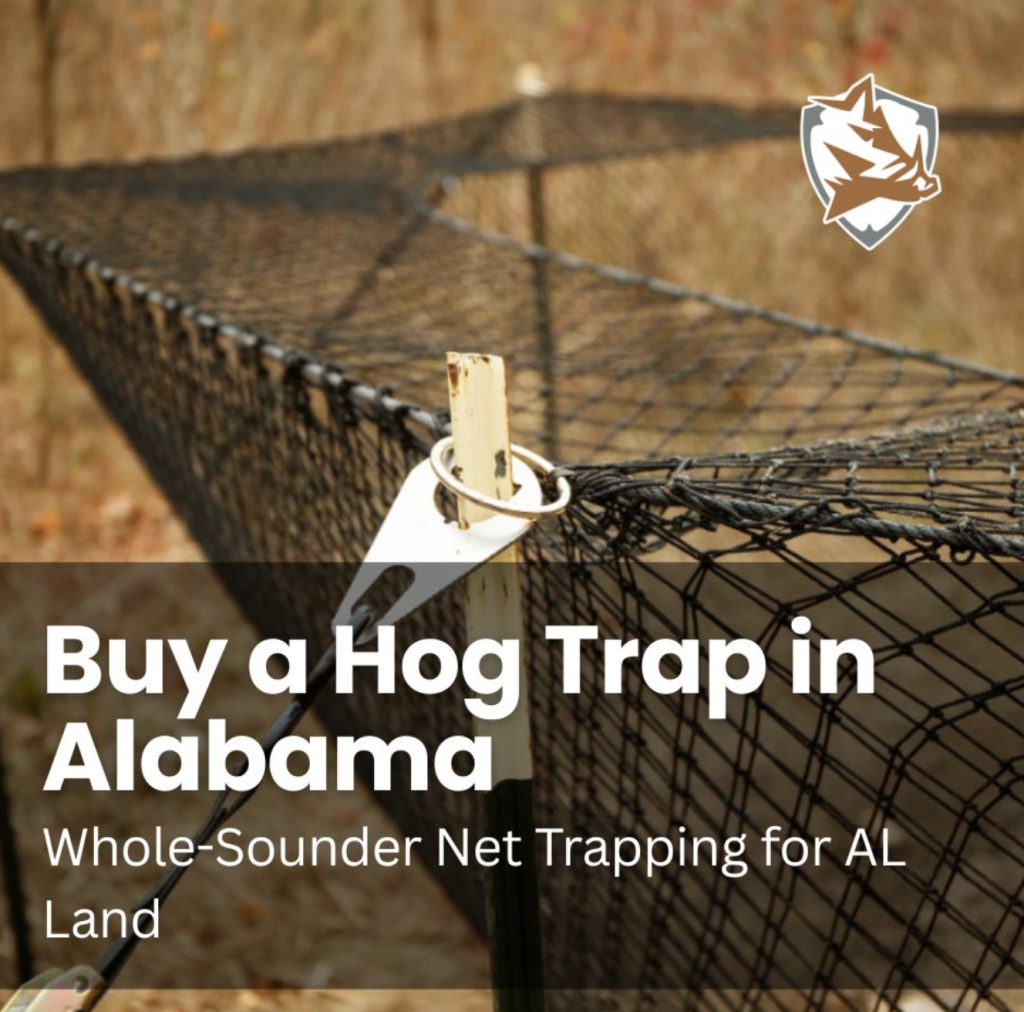
Alabama’s Feral Hog Problem: Black Belt, Wiregrass, and Timber Country
Feral hogs are established across Alabama from Black Belt row-crop ground to Wiregrass pastures, pine timber, and river bottoms. They root fields, wreck food plots, foul water, and breed faster than casual shooting can fix. For Alabama landowners and land managers, the practical question is how to remove whole sounders efficiently and legally.
This page is Alabama’s commercial trapping hub: rules to confirm, why a passive net fits AL terrain, and what a setup costs. Hunting-season context lives on our Alabama deer season and hogs notes; this hub is about trapping and buy intent.
What Alabama Law Expects You to Confirm
Feral hog rules change. Before you deploy, verify current requirements with the Alabama Department of Conservation and Natural Resources (ADCNR) / Outdoor Alabama. Treat the table below as a confirmation checklist, not legal advice.
| Rule area | What to confirm with ADCNR | Trapper action |
|---|---|---|
| Permits / licensing | Whether your private-land situation needs a permit | Verify before deploying |
| Trap monitoring | Required check interval for live traps | Plan checks (often every 12 hours) |
| Animal removal | Timeframe to remove trapped animals | Plan removal (often within 24 hours) |
| Live transport | Whether/how live hogs may be moved | Confirm before hauling anything live |
| Night / depredation | Provisions for night work and depredation | Match your plan to current rules |
Many states require live traps to be checked roughly every 12 hours with animals removed within about 24 hours for any catch, not just hogs. Confirm Alabama’s exact specifics with ADCNR.
Why Whole-Sounder Nets Fit Alabama Terrain
Box traps catch a hog or two and educate the rest. In Alabama’s thick cover and soft bottomland, that pattern fails: survivors scatter, get wary, and keep breeding. A net system seals a feeding footprint around the entire sounder. See how whole-sounder trapping works.
How the Boar Blanket Net Works
Install the net raised over an active feeding site, pre-bait, and watch attendance on camera. When the whole sounder feeds calmly and consistently, return and manually lower the net so the skirt rests on the ground. On the next visit the hogs push under the skirt and trap themselves: passive self-entrapment. No phone-actuated close, no drop mechanism, no power required. Full details: Boar Blanket trapping system.
Bait, Conditioning, and Summer Water in Alabama Heat
Budget 5 to 10 nights minimum of pre-baiting; pressured or large sounders commonly need up to 14. Refresh bait daily on camera. If a sounder hits an empty site two nights running, they shift. In Alabama heat, water anchors sites. If ground is dry, a mud hole from several buckets of water is a recognized summer technique. Do not close until the closure window is established and the complete sounder is inside.
Remote Monitoring Cuts Wasted Trips
Camera-based monitoring eliminates an estimated 70 to 80% of empty-trap check trips and helps you act inside compliance windows. The HogEye camera system is $1,299 and is the monitoring backbone for the lineup.
What an Alabama Trap Setup Costs
| Tier | Price | Best fit |
|---|---|---|
| DIY (T-posts, farm-gauge wire, gate, basic camera) | $800 to $2,500 | Smaller acreage, hands-on operators |
| Big Pig Traps drop trap + camera | from $4,499 | Steel trap for large-scale removal |
| Big Pig Traps 6-panel + 2-gate | from $5,695 | High-pressure, large sounders |
| HogEye camera system | $1,299 | Remote monitoring add-on |
Full comparison: feral hog trapping costs breakdown. National wild pig impact is at least $3.4 billion a year as a conservative minimum (Pest Management Science, 2025).
Compliance and Site-Selection Checklist
Confirm current ADCNR rules; pick sites with natural funnels and, ideally, water; pre-bait 5 to 10 nights; wait for the complete sounder; plan checks and removal inside Alabama’s required windows. Neighboring-state operators can compare buy a hog trap in Mississippi and browse when you shop hog traps by state.
Frequently Asked Questions
- Is feral hog trapping legal on private land in Alabama?
Control is generally practiced on private land, but specifics change. Confirm current rules and any permit needs with ADCNR before you deploy. - Do I need a permit to trap wild hogs in Alabama?
It depends on your situation. Verify with ADCNR rather than assuming; this guide is a checklist, not legal advice. - How often does Alabama require me to check a live trap?
Many states require checks about every 12 hours; confirm the exact Alabama interval with ADCNR. - Can I transport live feral hogs in Alabama?
Live transport is restricted in many states. Confirm what’s allowed with ADCNR before moving any live animal. - What trap works best in Alabama timber and bottomland?
A whole-sounder net system that seals the entire group rather than catching a few and educating the rest. - Can I use the Boar Blanket net trap in Alabama?
Yes. The passive net works without power or cell service. Operate within current ADCNR rules. - What does a hog trap setup cost in Alabama?
DIY runs $800 to $2,500; commercial systems start at $4,499; HogEye is $1,299. See the cost breakdown for detail. - Who do I contact about Alabama feral hog rules?
ADCNR / Outdoor Alabama is the starting authority for current regulations.