
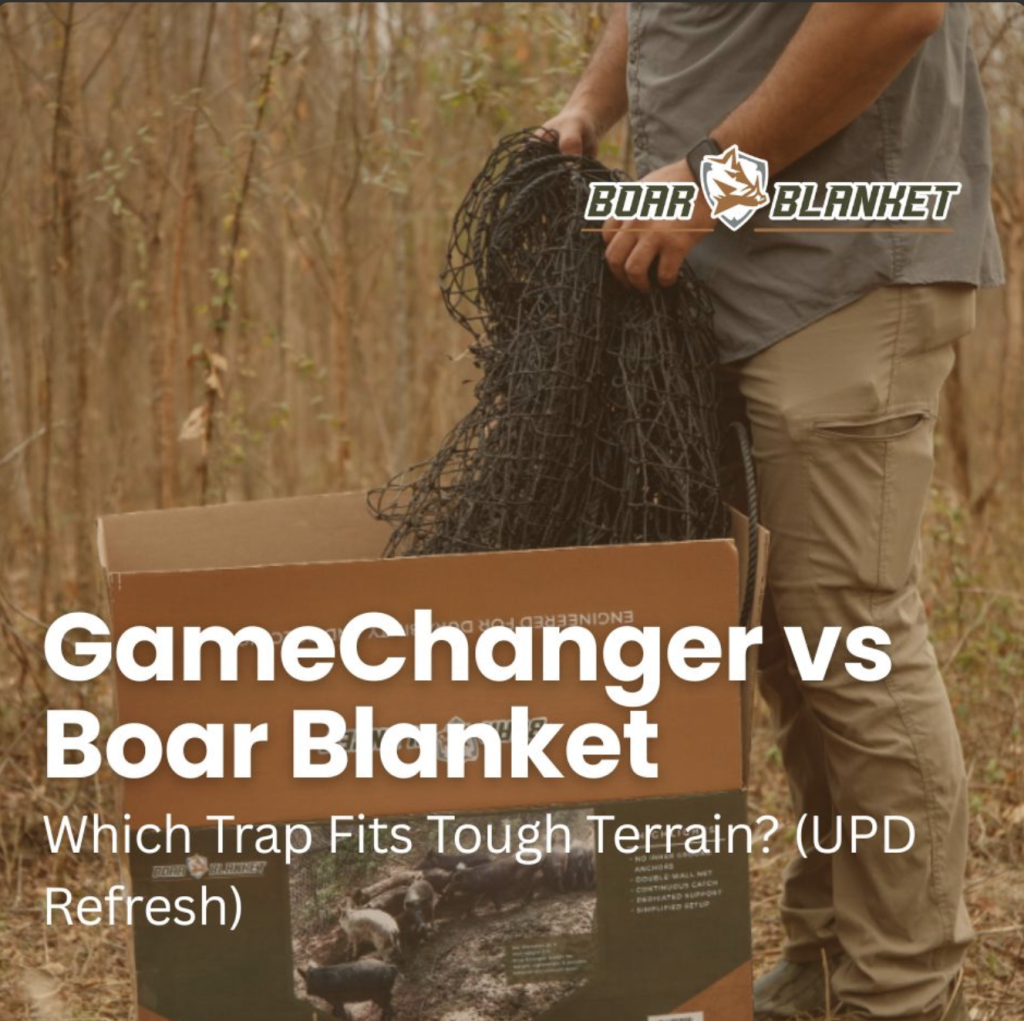
Tough Terrain Is Really a Site-Design Question
Searches for GameChanger vs Boar Blanket usually mean: which system still works when the ground is uneven, brushy, muddy, or awkward to stage. The honest answer starts with the feeding site, not the brand name. This refresh compares decision criteria and links related comparisons in the portfolio.
How the Boar Blanket Net Behaves on Difficult Ground
The Boar Blanket net wants an open feeding footprint where a sounder will commit to bait. Soft or uneven ground is workable when posts stay true and the skirt can seal. Capture remains passive: condition 5 to 10 nights (up to 14), confirm the whole sounder, then manually lower the net. No phone-actuated close, no drop mechanism. Specs and process: Boar Blanket trapping system.
| Terrain challenge | What to solve first | Net-program note |
|---|---|---|
| Soft mud / Delta-style ground | Stable posts; skirt seal | Water nearby often helps hold sounders |
| Brush / tight timber | Clear a feed opening | Nets need a committed open bait pad |
| Hills / cutbanks | Level enough footprint | Do not force a bad site |
| Remote / no cell | Passive capture path | BB net does not need connectivity to catch |
| Multi-site rotation | Pack-down and move time | Soft nets relocate faster than heavy steel |
How to Evaluate Any Competing System (Including GameChanger)
Read the manufacturer’s current setup guide. Ask: Does capture require power or cell? What is the conditioning expectation? How does the system fail when part of a sounder hesitates? Can one person relocate it? Stay respectful of other products; judge them on published mechanism and your land, not on marketing adjectives.
Whole-Sounder Discipline Beats Hardware Hype
On tough terrain, the expensive failure is still a partial catch. Survivors learn the site. Population math does not care which logo was on the net. Anchor your program with whole-sounder trapping doctrine, and compare category trade-offs in cage vs net and Boar Blanket vs Pig Brig.
When Steel or Corral Systems Win
Fixed high-pressure sites often favor rigid panel systems and operator-commanded gate closure (for example, Big Pig Traps with HogEye). When referencing these systems, state clearly that the gate or trap closes only once the entire sounder is committed to the site. Pricing context: trapping costs breakdown.
A Simple Decision Path
If you can create an open bait pad and will wait for the full sounder, a passive net is a strong fit, including on soft ground when staged correctly. If your site cannot offer that footprint, solve site selection before buying any trap. Materials that hold under pressure: best materials for a hog trap.
Frequently Asked Questions
- Is GameChanger or Boar Blanket better in mud?
Either can fail if the site cannot hold a seal. Prioritize post stability, skirt contact, and sounder commitment over brand preference. - Does the Boar Blanket net need cell service on remote land?
No. Capture is passive after the trapper manually lowers the net. - What terrain is a poor fit for a net?
Sites with no open feeding pad and no way to get a ground seal. Fix the site or choose another method. - How long should conditioning take on pressured land?
5 to 10 nights typical; up to 14 when sounders are wary or large. - Should I compare Pig Brig, too?
Yes, if you are shopping for net-style systems. See our Boar Blanket vs Pig Brig comparison. - When should I choose a steel corral instead?
Fixed, high-cycle commercial sites that need rigid panels and remote gate closure options. - What is the success metric?
Whole-sounder capture without educating survivors, not a single-night body count. - Where are the Boar Blanket specs?
On the Boar Blanket trapping system page.