
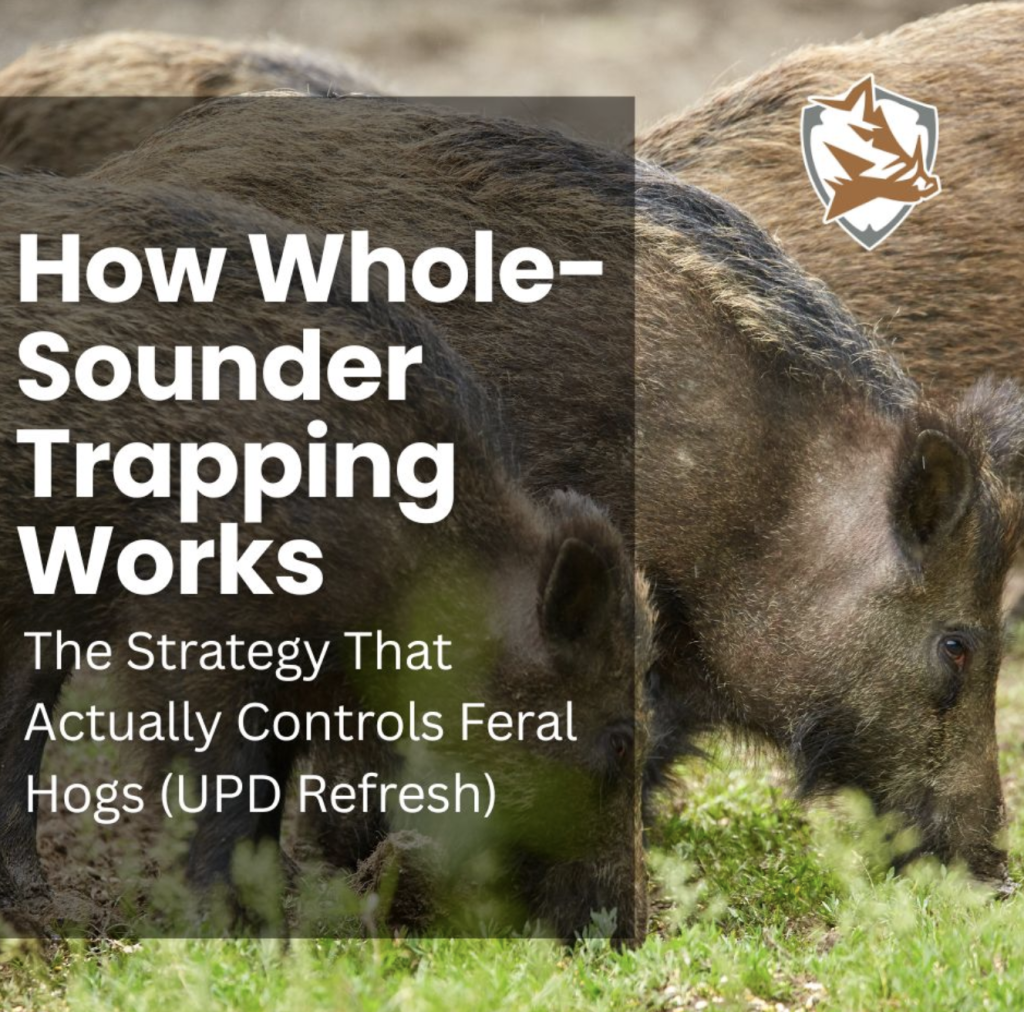
What "Whole-Sounder Trapping" Means
Whole-sounder trapping means capturing the entire family group, cows, juveniles, and piglets that travel together in one event. It is the opposite of picking off a few animals and teaching the rest to avoid people, dogs, and traps. If your program still measures success by single-night body counts, this refresh is the reset.
Why Partial Captures Make the Problem Worse
Catch part of a sounder and the survivors become trap-shy. They shift patterns, breed, and pass wariness forward. Months of work can be erased by one early close. That is why the closure rule is non-negotiable: do not close the gate or lower the net until the complete sounder is committed.
| Phase | Nights (typical) | What you should see |
|---|---|---|
| Discovery | 1 to 2 | No contact, or a single edge passer |
| Scout | 3 to 5 | Mature sow evaluates the site |
| First full approach | 5 to 8 | First full-group visit |
| Full conditioning | 8 to 10+ | Reliable closure window (up to 14 if pressured) |
The Conditioning-Then-Capture Sequence
Find an active feeding site. Stage the trap. Pre-bait and monitor with cameras. Wait until the whole sounder feeds calmly and consistently. Only then does the gate or trap closes. For the Boar Blanket net, that means the trapper returns and manually lowers the net for later passive self-entrapment. There is no phone-actuated close on the Boar Blanket net. Product walkthrough: Boar Blanket trapping system.
Bait Discipline and Summer Water
Keep bait refreshed. If a sounder hits an empty site two nights running, they move. In summer (June to August), sites near water significantly out-produce dry sites; creating a mud hole with several buckets of water is a recognized technique. Baiting tactics: baiting hog traps guide.
Why Monitoring Exists
Remote monitoring is not about gadgets for their own sake. It cuts an estimated 70 to 80% of empty-trap check trips and tells you when the closure window is real. HogEye is $1,299 when you need cellular solar monitoring on corral or compatible setups.
Why the Strategy Matters Economically
Wild pigs impose at least $3.4 billion a year in U.S. costs as a conservative minimum (Pest Management Science, 2025). Programs that only harass sounders keep paying that bill locally. Cost tiers for equipment: feral hog trapping costs. Category choice: cage vs net.
How to Start on Your Ground
Map travel and feed sites, pick one sounder, commit to the full conditioning window, and refuse early closes. State hubs: Texas, Mississippi, Alabama, and shop by state.
Frequently Asked Questions
- What is a sounder?
A family group of feral hogs typically includes sows, juveniles, and piglets that travel and feed together. - Why is whole-sounder trapping more effective than hunting?
Hunting removes individuals; whole-sounder trapping removes the breeding unit before survivors learn the trap. - How long should I pre-bait?
5 to 10 nights minimum; up to 14 for pressured or large sounders. - What happens if I catch only part of the sounder?
Survivors become trap-shy and keep breeding, frequently setting the program back by months. - Does the Boar Blanket net close from a phone or app?
No. The trapper manually lowers the net; hogs trap themselves on a later visit. - Do I need cell service?
Not for Boar Blanket net capture. Cameras help you time the close, but are not the capture mechanism. - Where does water fit in summer?
Sites near water outperform dry sites; mud holes can anchor sounders when natural water is scarce. - Where should I buy a system?
Start with the trapping system page and your state hub via shop-by-state.