
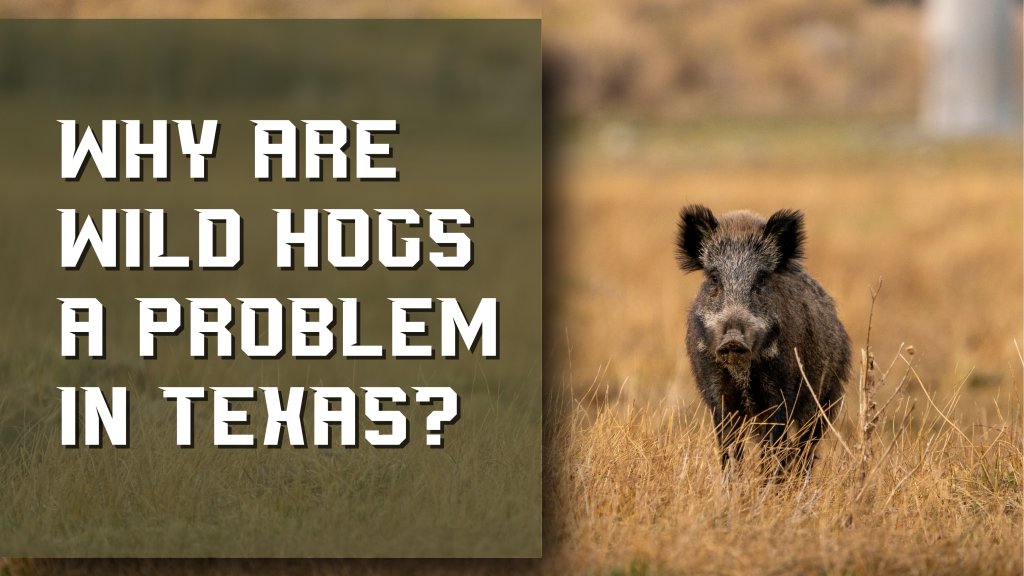
Why are wild hogs a problem: If you’re a Texas landowner, rancher, or property manager, chances are you’ve seen the damage firsthand. Rooted-up pastures, busted fences, broken waterlines, trampled crops. You’re not imagining it: wild hogs are an escalating problem across the state, and they’re costing Texans dearly.
The Scale of the Feral Hog Problem in Texas
With more than 3 million feral hogs roaming the state, Texas has the largest wild hog population in the U.S. These invasive animals are now confirmed in 253 out of 254 counties. According to the Texas Department of Agriculture and USDA, wild hogs cause more than $500 million in damage annually — destroying farmland, equipment, and ecosystems.
This is no longer just a rural nuisance. From suburban neighborhoods outside Houston and Austin to hunting leases in East Texas and cattle land in the Hill Country, hogs are expanding faster than most trapping strategies can contain them.
Why are Wild Hogs a Problem?
Feral hogs aren’t just large — they’re aggressive, fast-moving, and environmentally destructive.
They:
- Root and tear through crops, hay fields, and pastureland
- Destroy fences, gates, feeders, and waterlines
- Eat livestock feed, eggs, and small animals
- Cause erosion and soil degradation
- Compete with deer and cattle for food and habitat
These animals can travel 5 to 15 miles in a single night, making them difficult to monitor and even harder to trap with conventional methods.
5 Reasons Wild Hogs Are So Hard to Control in Texas
- Rapid Reproduction: Females can reproduce at 6 months old and birth 2–3 litters per year, with 4–8 piglets per litter.
- Highly Intelligent: Once a sounder sees a trap fail, they adapt quickly and become “trap shy.”
- Nocturnal Behavior: Most movement occurs at night, limiting visual detection.
- Diverse Terrain: Texas’ mix of brush country, pine forests, swamps, and dry plains makes consistent trapping a challenge.
- Poor Cell Coverage: Many remote ranches lack the connectivity needed for cellular trap gates or remote camera triggers.
Are Wild Hogs Dangerous to People or Pets?
Can feral hogs attack humans?
Yes, especially if startled or cornered. While rare, there have been documented attacks, particularly by protective sows or aggressive boars.
Do they spread disease?
Absolutely. Feral hogs can carry swine brucellosis, pseudorabies, leptospirosis, E. coli, salmonella, and other pathogens that can spread to humans, pets, and livestock. Learn more in our FAQ page.
Are they a risk to pets or wildlife?
Yes. Hogs have been known to kill fawns, turkey poults, and ground-nesting birds. They raid nests and compete with native species for food and habitat.
In short: they’re not just a land issue — they’re a health and safety issue.
Why are Wild Hogs a Problem and Why Traditional Hog Traps Often Fail in Texas?
Standard drop traps and cage traps — even high-end ones — often fall short.
- Drop traps require near-perfect timing and surveillance.
- Remote cellular traps need reliable signal (rare in rural TX).
- Cage traps only catch a portion of the sounder, leaving the rest to escape and learn.
- Trigger-based systems make noise, alerting and scaring the pigs.
What happens if you catch 2 out of 12 pigs?
- You’ve just trained the other 10 to avoid all future traps.
- Those pigs disperse and become even harder to catch.
This is why full-sounder capture is so critical.
Related: GameChanger vs Boar Blanket: Which Trap Handles Tough Terrain Better?
What Landowners Need Is Full-Sounder Capture
To truly reduce feral hog populations, especially in a state as large and varied as Texas, traps must:
- Allow natural entry without sound or motion triggers
- Be silent, low-profile, and passive
- Avoid needing cellular or satellite tech
- Be easy to deploy by one person
So, what is a Boar Blanket?
Boar Blanket is a net-based hog trap that lays flat on the ground during conditioning and lowers for trapping. As hogs push under to feed, the net’s tapered design naturally encloses them. There are no drop gates, no loud triggers, and no electricity or signal required.
It’s:
- Quiet
- Portable
- Field-tested across Texas terrain
And it’s designed to capture the entire sounder in one shot.
Why are Wild Hogs a Problem and What Can You Do Today?
If you’re seeing signs of hogs on your land, rooting, wallows, hoof tracks and scat don’t wait. Here’s how to act:
- Survey your land for recent hog activity.
- Pre-bait the area with corn in long lines, no traps yet.
- Condition the hogs over several days to return consistently.
- Set up a system that’s passive, low-risk, and efficient, like Boar Blanket.
Explore our Texas Hog Trap Guide to see how Boar Blanket helps landowners regain control, quietly, affordably, and effectively.