
Introduction: The Hard Truth Behind the “Just Hunt Them More” Mindset
Across the South and Midwest, hunting is one of the most common responses to rising hog damage. Many landowners assume that if enough people hunt, hog populations will decline over time, but field data tells a different story.
Hunting is valuable for recreation and opportunistic removal. Yet it remains one of the least effective population control methods when used alone. In most areas, hunting not only fails to reduce hog numbers but can unintentionally make hogs harder to manage.
This article explains why, using data that every landowner and trapper should understand before planning a control strategy.
The Population Math: Why Hunting Cannot Keep Up Hog Populations
Feral hog populations grow at one of the fastest rates of any large invasive mammal in North America. Their reproductive capacity creates a steep “recovery curve,” meaning they rebound quickly after partial removals.
Annual Removal Requirements
Management research shows that 60 to 75 percent of a local hog population must be removed every year to stabilize or reduce numbers. Anything below that threshold results in population growth.
What Hunting Actually Achieves
In most regions, hunting removes less than 30 percent of hogs annually. That number includes:
- Opportunistic hunting during deer season
- Night hunting
- Thermal and spot-and-stalk hunting
- Dog-assisted hunting
- Private and public land harvests combined
Even with increased pressure, legal night hunting, and modern thermal equipment, removal rates rarely approach what is needed for population control.
Table: Hog Populations – Reduction Needs vs. Hunting Removal
| Management Requirement | Percentage Needed per Year | Typical Removal by Hunting | Outcome |
| Stabilize population | 60–65% | ~20–30% | Population continues to grow |
| Reduce population | 70–75% | <30% | Population grows even faster |
| Opportunistic removal | <20% | <20% | No measurable impact |
| Whole-sounder trapping | 60–100% per event | Results vary | Only method proven to meet control thresholds |
Hunting simply cannot achieve the removal rate needed to slow growth because the math is stacked heavily in the hog’s favor.
How Hunting Changes Hog Behavior in Counterproductive Ways
When hunting pressure increases, hogs do not become easier to find. They become more cautious, more nocturnal, and more mobile.
Avoidance and Nocturnal Shift
Hogs quickly learn to avoid areas where shots are fired or human scent is concentrated. Under heavy pressure they:
- Feed later at night
- Shift to thicker cover
- Travel farther
- Scatter into smaller groups
This makes them harder to predict and harder to trap.
Sounder Fragmentation
Shooting into a sounder removes a few hogs but disrupts the social group, causing the remainder to scatter.
Scattered groups:
- Become more wary
- Visit bait sites less consistently
- Arrive at unpredictable times
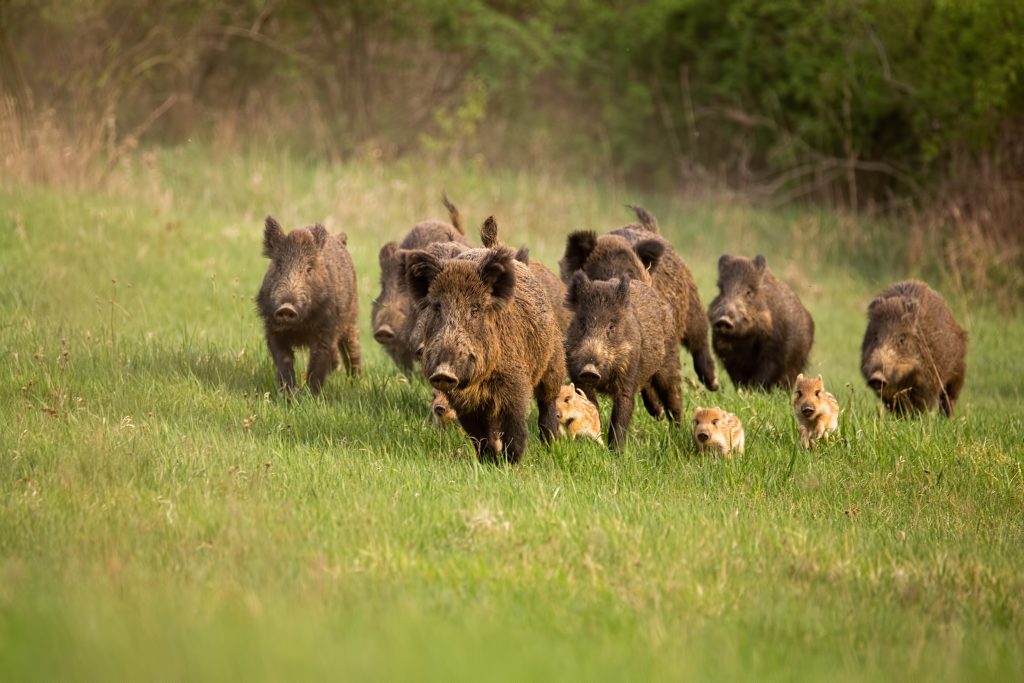
This reduces the chances of capturing entire sounders, which is necessary for real population control.
Displacement Across Properties
Hunted hogs frequently move onto neighboring properties, meaning hunting pressure can shift the problem rather than reduce it.
For deeper background on population dynamics, see the Feral Hog Crisis long-form report.
Why Hunting Appears Effective but Doesn’t Reduce Hog Populations
Hunting often creates the illusion of progress because hog encounters are frequent, especially in high-density counties. Shooting one or two hogs feels productive, but population modeling shows that partial removal rarely changes long-term numbers.
High Visibility ≠ High Effectiveness
Landowners often report seeing hogs regularly, assuming that frequent encounters mean hunting is thinning the herd. In reality, regular sightings usually indicate the population is already too large.
More Hogs Seen Often Means More Hogs Present
In many states, the number of hog sightings increases each year, yet hunting harvests remain the same or decline.
This is a sign that hunting is not keeping pace with reproductive growth.
The Trap-Triggered Feedback Loop
When hogs become more nocturnal and more wary after hunting pressure, bait sites show:
- Erratic visitation patterns
- Reduced group size
- More partial entries
- More interrupted feeding cycles
This disrupts the consistency needed for successful full-sounder trapping.
This is why many state agencies recommend avoiding aggressive shooting during trapping operations. The goal is to keep sounders calm, predictable, and fully committed to the bait site.
To learn why this method is effective, see Whole Sounder Trapping.
Lessons from States With Heavy Hunting Pressure
States like Texas, Oklahoma, Georgia, and Florida have year-round hog hunting with very few restrictions. Despite this, hog populations have continued to grow across nearly all regions.
Case Insight: Georgia’s Management Approach
Georgia offers one of the clearest examples of why hunting alone is ineffective.
With long seasons, night hunting permissions, and tens of thousands of hog hunters, the state still:
- Reports expanding hog distribution
- Experiences millions in agricultural losses
- Recommends trapping as the primary control strategy
This is why this article requires a backlink from the Georgia Deer and Hog Hunting Guide.
Why Trapping Works When Hunting Doesn’t: It Targets the Whole Sounder
The difference between hunting and whole-sounder trapping is not philosophical. It is mathematical.
Hunting removes one or two hogs at a time.
This does little to dent reproductive capacity.
Whole-sounder trapping removes 80 to 100 percent of a group at once.
This is the only method that consistently achieves the 60–75 percent annual removal required for population control.
Across the South, landowners who transition to full-sounder trapping see measurable reductions in:
- Rooting
- Crop losses
- Nighttime activity
- Reproductive pressure
For anyone evaluating trapping systems, the comparison cluster provides detailed breakdowns. See comparison posts such as the Boar Blanket vs Pig Brig or Boar Blanket vs GameChanger articles.
Avoiding the Hunting Trap: How to Integrate Hunting Without Disrupting Control
This blog is not an argument against hunting. It is an argument for strategic integration.
Best practices include:
- Avoid shooting near active bait sites
- Avoid shooting at sounders that are being conditioned for trapping
- Hunt only outside active trapping zones
- Use hunting to remove transient boars, not resident sounders
- Coordinate hunt timing with trapping operations
These practices preserve calm, predictable sounder behavior while still allowing recreational harvest.