
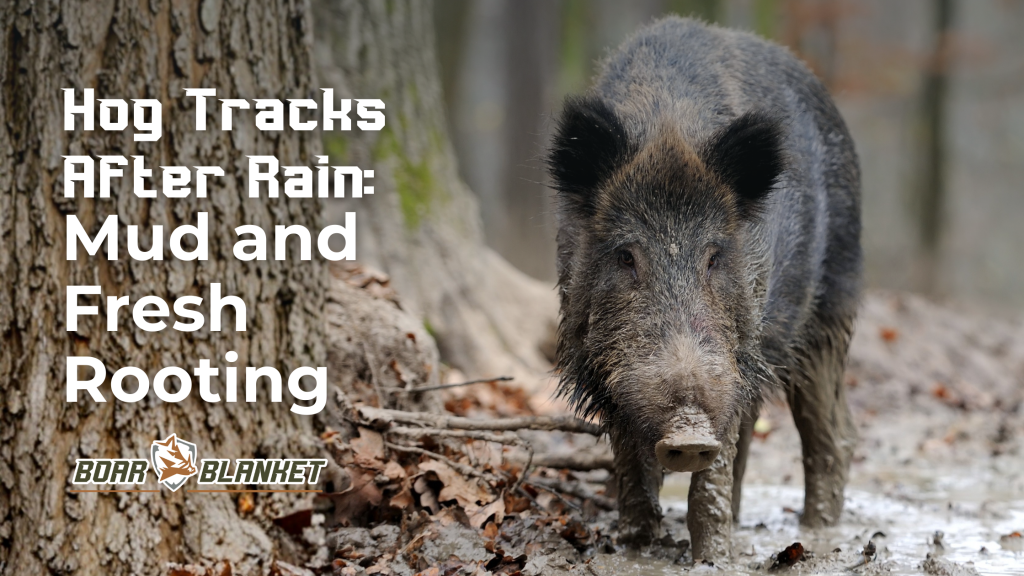
Rain Resets the Ground and Reveals the Truth
For trappers and landowners, a soaking rain is not just weather. It is a reset button. Old prints soften. Dust layers disappear. Fresh hog tracks, wallows, and rooting show up in sharp relief.
If you know what to look for in hog tracks after rain, especially in the 24 to 72 hours following a storm, you can quickly distinguish between historic hog activity and a sounder that is on your property right now. This blog builds on the foundation in Signs of Wild Hogs and January’s Hog Tracks, Trails and Travel Patterns to focus specifically on wet-weather scouting.
Explore more Signs of Wild Hogs
Why Rain Makes Hog Sign Easier to Read
Rain changes the soil in ways that highlight hog activity:
- Softens the surface so hooves sink deeper and edges stay crisp.
- Reveals moisture differences where soil has been disturbed or turned.
- Creates mud transfer on logs, rocks, and fence wire as hogs move.
Because of this, the day after a storm is one of the best times to confirm:
- Current travel routes
- Group size and direction of movement
- Whether rooting is exploratory or part of a regular feeding pattern
Reading Hog Tracks in Wet or Muddy Ground
In wet conditions, track detail becomes more obvious, but you must also account for how quickly water can degrade prints.
Key indicators of fresh hog tracks after rain:
- Crisp edges and defined dewclaws: Clear outlines with visible toe separation suggest very recent passage.
- Minimal silt or debris in the track: If the print is still clean inside and not filled with washed-in material, it is likely less than a day old.
- Water pooled in hoof depressions: On flat ground, standing water in the track often indicates hogs passed after the main rainfall but before full drainage.
Use January’s Hog Tracks, Trails and Travel Patterns for a deeper review of track shape, size, and species identification. This February article assumes you can already tell hog prints from deer or cattle.
Read more in our Hog Tracks, Trails and Travel Patterns blog
Mud Patterns That Confirm Active Hog Tracks and Travel Routes
Mud does more than hold prints. It travels with the hogs and collects on obstacles they pass.
Look for:
- Mud smears on low fence wire: Especially where hogs push under or between strands.
- Mud on tree trunks or posts at knee height: Repeated rubbing as hogs squeeze through tight cover.
- Dragged mud across rocks or logs in creek crossings: Indicates frequent use, not a one-time crossing.
These patterns often pinpoint bottlenecks where you can place cameras or future traps with high confidence.
Fresh Rooting After Rain: How It Connects to Hog Tracks
Fresh rooting is usually easier to see after rainfall because:
- Wet soil holds the shape of turned clods and nose plows.
- Color contrast between dark, wet subsoil and lighter surface material is sharper.
- Odor from freshly disturbed organic matter is stronger.
Use the table below to separate fresh rooting from older, inactive damage.
| Rooting Sign | Appearance After Rain | What It Indicates | Priority Level |
| Fresh rooting | Sharp edges, moist soil, plant roots exposed, little regrowth | Recent feeding, likely within last 24–48 hours | High – deploy cameras or start bait conditioning |
| Weathered rooting | Rounded edges, some silt in holes, early grass regrowth | Older activity, sounder may have shifted | Moderate – monitor but focus elsewhere |
| Smoothed or flattened rooting | Depressions visible but surface more level, heavy regrowth | Historic activity, not a current hotspot | Low – use as background context only |
Focusing on the first category keeps your time and resources aimed where hogs are actually feeding now.
Using Rain Windows to Map Sounders Through Hog Tracks
A single storm can give you a clean snapshot of hog distribution across your property.
Practical steps:
- Wait 12 to 24 hours after heavy rain so hogs have time to move and feed.
- Walk primary travel zones – along edges of crops, creeks, pasture-to-woods transitions, and known bedding cover.
- Note direction of travel by studying track orientation in multiple spots.
- Mark convergence points where trails, tracks, and fresh rooting overlap.
Within one or two such “rain windows,” you can usually identify which fields or pastures are being hit most often and how sounders are moving between them.
Connecting Wet-Weather Sign to Regional Patterns
Rainfall patterns are different in the Arkansas Delta than in central Texas or coastal Louisiana. Your Regional State Guides provide context on:
- Typical winter and spring rainfall by region
- Soil types that hold or shed water quickly
- Common hog travel corridors in that specific landscape
Use that information to decide which parts of your property deserve priority after storms.
Explore our Regional State Guides
Let Rain Do Half The Scouting For You
You cannot control when it rains, but you can control what you do afterward. If you consistently walk fields and edges after storms, the land will show you exactly where hogs are spending their time.
Once those wet-weather patterns are clear, it becomes much easier to decide where to place cameras, where to pre-bait, and where a quiet, ground-level trap will have the highest chance of catching the entire sounder instead of just a few stragglers.