
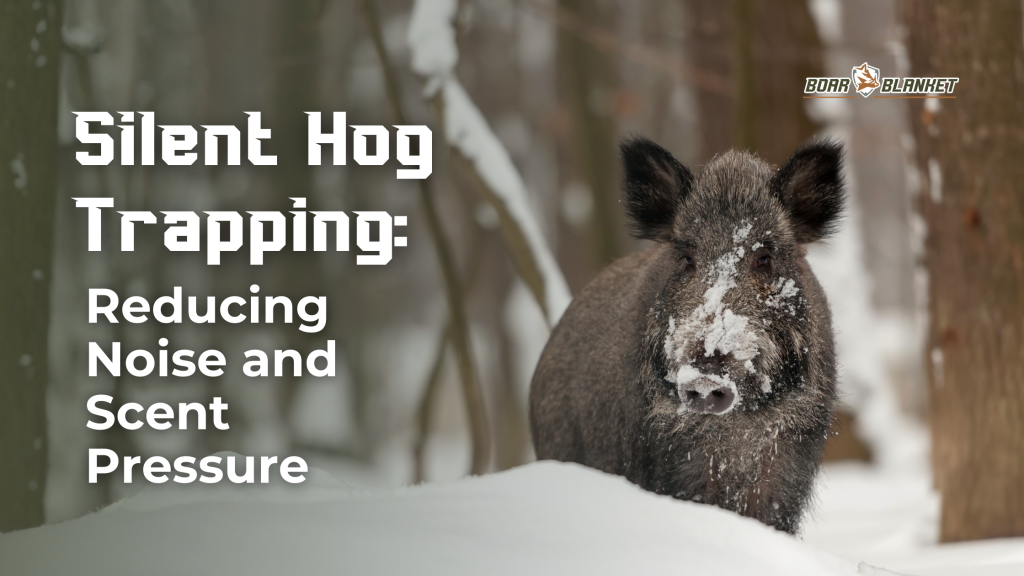
Hogs Learn Fast When You Make Noise
Most landowners blame “trap-shy hogs” on intelligence alone. In reality, hogs are responding to what they experience around your setup: loud equipment, disruptions to natural hog scent patterns, strong human scent, bright lights, truck patterns, and sudden changes in their environment.
Over time, sounders learn to avoid specific traps, feeders, or fields not because they cannot be caught, but because trapping pressure has been loud, obvious, and inconsistent.
Silent, low-pressure trapping is one of the biggest competitive advantages you can create on your property. This article explains why noise, scent, and human pressure matter and how to adjust your approach.
How Hogs Use Scent to Evaluate Your Trap Site
Hogs move through the world with three primary warning systems:
- Nose: Exceptional ability to detect human scent, fuel, chemicals, and unfamiliar odors.
- Ears: Sensitivity to clanging metal, vehicles, and unnatural mechanical sounds.
- Memory: Strong association between danger and specific locations, structures, and stimuli.
When these senses repeatedly flag a trap site as risky, hogs may:
- Approach and circle but never commit to the bait.
- Visit in smaller subgroups instead of as a full sounder.
- Shift feeding to nearby fields, neighbors’ feeders, or harder-to-access cover.
The result is fewer captures and more educated hogs.
Common Noise Mistakes Around Hog Traps
Certain sounds consistently spook hogs, especially at or near bait sites:
- Banging T-posts in hard soil right next to fresh rooting.
- Letting panels, gates, or nets drag and scrape across steel beds.
- Driving trucks or ATVs directly to bait locations every visit.
- Slamming doors, talking loudly, or working with tools after dark.
Over time, hogs learn that these noises predict disturbance. They may still use the general area, but they will skirt the trap itself, feed quickly, or restrict movement to deeper night hours.
Scent And Human Presence: How You Disrupt Natural Hog Scent
Even when you are quiet, your scent can undo weeks of careful baiting. Mistakes include:
- Handling bait with bare hands and dropping it directly where hogs feed.
- Standing or walking repeatedly in the center of the bait site.
- Leaving fuel, tobacco, or chemical smells on buckets or equipment.
- Visiting the trap at inconsistent times, especially during peak feeding hours.
Because hogs and deer often share habitat, mistakes that educate hogs can also push deer off patterns, as explained in Do hogs affect deer movement. Protecting both species starts with managing pressure.
Visible Pressure: Lights, Cameras and Vehicle Patterns
Technology is helpful when used carefully, but it can add pressure if handled poorly.
- Bright white lights used for checking traps at night.
- Cameras mounted low and obvious where hogs can see or bump them.
- Frequent vehicle access at the same times hogs like to approach.
Instead, aim to:
- Use discreet infrared lighting or check traps during daylight whenever possible.
- Mount cameras slightly higher, angled down, and off the main entry path.
- Vary approach routes and limit visits to necessary baiting and maintenance.
Why Silent, Passive Systems Capture More Sounders
Trapping systems designed to be quiet and low-profile have a built-in advantage. When hogs can enter and feed without:
- Hearing a gate slam
- Seeing tall steel walls
- Feeling sudden mechanical motion
they are more likely to stay relaxed, bring the entire sounder, and feed for longer periods. This is exactly the environment you want before switching into capture mode.
Whole-sounder methods rely on hogs feeling safe enough to commit as a group. Systems and setups that are naturally quiet and close to the ground make that easier.
Explore Whole-sounder trapping strategies
The Boar Blanket Case Study highlights how a silent, ground-deployed net held an entire sounder calmly for hours without the stress and noise associated with metal cages or drop gates.
Explore our Boar Blanket Case Study
Quick Audit: Is Your Setup Loud Or Low-Pressure
Use the table below as a self-check before your next trapping cycle.
| Pressure Factor | High-Pressure Signs | Low-Pressure Alternative |
| Installation noise | Heavy hammering, cutting, vehicle idling at site | Pre-drive posts during daytime, carry in lightweight gear |
| Scent control | Handling bait bare-handed, standing in bait center | Use gloves, approach from downwind, place bait without lingering |
| Visit frequency | Daily or multiple times a day near peak feeding | Fewer, planned visits outside core activity windows |
| Visual disturbance | Bright lights, obvious new structures | Low-profile gear, minimal lighting, gradual changes |
Small adjustments in each category can dramatically improve how comfortable sounders feel at your trap locations.
Make Silence Part Of Your Strategy
Capturing hogs consistently is not only about where you place traps. It is about how you run them.
When you reduce noise, manage scent carefully, and limit visible pressure, you allow hogs to treat your trap sites as just another safe feeding stop. Silent, passive systems take this a step further by removing the loud mechanical events that often educate sounders after the first capture.
If you are upgrading or refining your trapping program this season, evaluate every tool and habit through that lens: Will this help my setup stay quiet and low profile, or will it teach hogs to avoid the area altogether.